The Attic Problem: Why Your Organization Keeps Paying Rent on Data It Will Never Use Again

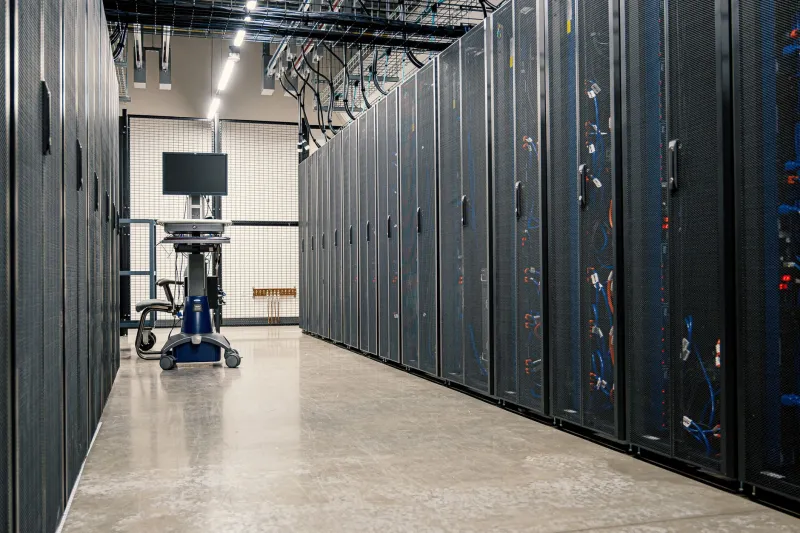
Photo: Hetzner Online GmbH, CC BY-SA 4.0, via Wikimedia Commons
Every organization has one: a digital attic. Somewhere in your cloud storage accounts sits a 2014 marketing campaign nobody remembers, server logs from an application that was decommissioned years ago, and the seventeenth copy of a spreadsheet that three departments have each been 'maintaining' independently.
The uncomfortable truth is that storage is one of the few IT line items that only moves in one direction. Files don't shrink. Datasets don't volunteer for deletion. And unlike a physical attic, which at least has a fixed capacity, cloud storage expands effortlessly — and your invoice expands right along with it.
The problem isn't the cloud. It's the absence of a lifecycle.
The Compounding Cost of Keeping Everything
Storage pricing looks cheap in isolation. A few tenths of a cent per gigabyte per month sounds negligible until you multiply it across petabytes, replicated across availability zones, backed up twice, and indexed by a search service that also charges by the gigabyte.
The real expense is rarely the base rate. It's the ecosystem of costs that attaches itself to every retained byte: egress fees when someone finally does need that archived file, retrieval charges on archive tiers, compliance overhead for data you're legally obligated to protect whether or not it has value, and the security exposure of holding sensitive records nobody has reviewed since the previous administration.
There's also a quieter cost. When analysts and engineers must sift through years of accumulated noise to find relevant data, productivity suffers. Searches slow down. Backups take longer, which means backup windows stretch and teams defer them. Poor data hygiene doesn't just cost money — it degrades every process that touches the data.
Start With a Retention Policy, Not a Cleanup
The instinctive response to a bloated storage bill is a cleanup project. Resist that instinct, at least initially. A one-time purge without a governing policy simply resets the clock on the same trajectory. Within three years, you'll be back where you started.
A data retention policy answers one question for every category of information your organization holds: how long must we keep this, and what happens afterward?
In the US context, the answer is shaped by a patchwork of requirements. Tax and financial records generally carry seven-year retention expectations under IRS guidance. Healthcare organizations must account for HIPAA's six-year documentation requirements. Public companies operate under SOX record-keeping rules. Employment records, environmental compliance data, and industry-specific regulations add further layers — and several state-level privacy laws, including the California Consumer Privacy Act, create deletion obligations that cut in the opposite direction.
The practical approach is to work with legal counsel to build a simple matrix: data type, retention period, regulatory basis, and disposition method. Most organizations discover that a surprisingly large share of their stored data has no retention requirement at all. It's kept out of habit, or out of a vague fear that deleting something might matter someday.
Classify Before You Migrate
Once a policy exists, the next step is classification. Not all data ages the same way, and treating it uniformly is precisely what makes storage bills balloon.
A useful framework sorts data into three broad temperature bands:
- Hot data — accessed daily or weekly. Active databases, current project files, live application logs. This earns premium storage.
- Warm data — touched monthly or quarterly. Recent completed projects, last year's financial records, logs you occasionally query. Mid-tier storage fits here.
- Cold data — untouched for a year or more. Historical records retained for compliance, old backups, legacy project archives. This belongs in archive tiers priced at a fraction of standard rates.
Classification can be done manually for small environments, but at scale it should be automated. Most major cloud platforms offer object tagging and lifecycle rules that can move data between tiers based on access patterns. Third-party data management tools can scan for duplicate files, identify stale content by last-accessed metadata, and flag records containing sensitive information that require special handling.
Expect surprises. Organizations routinely find that 60 to 80 percent of their stored data qualifies as cold — meaning the majority of their storage spend is going toward information nobody has opened in years.
Let Automation Do the Enforcing
A policy in a PDF is a suggestion. A policy encoded in lifecycle rules is a guarantee.
Every major cloud provider — AWS, Azure, Google Cloud — supports storage lifecycle policies that automatically transition objects between tiers or expire them entirely after a defined period. A log bucket can be configured to move to infrequent-access storage after 30 days, to archive after 90, and to delete after the retention period ends. No meetings, no memos, no reliance on an engineer remembering to clean up.
Two cautions deserve attention. First, archive tiers often carry retrieval fees and minimum storage durations, so cold data should be genuinely cold before it lands there. Pulling a file out of deep archive for an audit can cost more than a year of standard storage. Second, deletion rules should always be reviewed against your retention matrix — automated expiration that runs afoul of a legal hold can create serious liability. Most platforms support litigation hold mechanisms that suspend expiration for flagged records.
Make It an Ongoing Discipline
Data lifecycle hygiene is not a project; it's an operating practice. Organizations that keep storage costs proportional to their actual needs tend to share a few habits: quarterly reviews of storage growth by department, chargeback or showback reporting so business units see the cost of their own accumulation, and an onboarding process that assigns retention rules to new data sources at creation, not years later.
The attic, in other words, never gets cleaned once. It gets maintained.
Your files will never shrink on their own. But with a retention policy grounded in real regulatory requirements, a classification scheme that matches storage tiers to actual usage, and automation that enforces both, you can ensure that every dollar of storage spend is buying something your organization actually needs — rather than rent on a past it has already forgotten.